Waves in magnetoactive materials

A magnetoactive polymer is a polymer matrix filled with magnetic particles; in my experiments, iron powder in 3D-printed PLA. A magnetic field acts on the particles and, through them, on the polymer, so the field can change how the material carries elastic waves.

My PhD asks which waves a field can tune, by how much, and with which models the answer can be trusted.

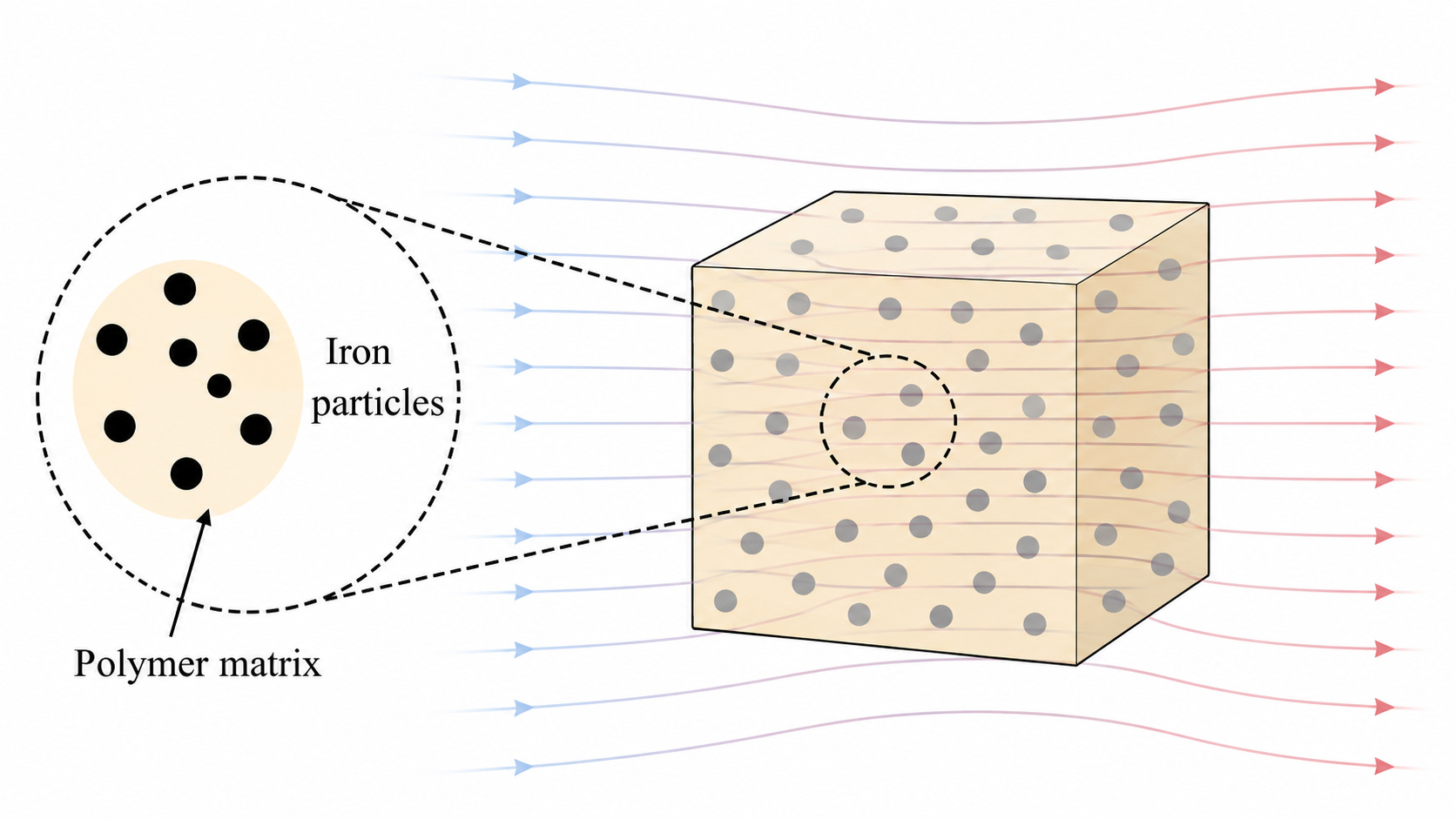
A cube of magnetoactive polymer under magnetic field lines, with a magnified view showing iron particles in the polymer matrix.
A magnetoactive polymer: iron particles in a polymer matrix, under a magnetic field.

Bulk waves

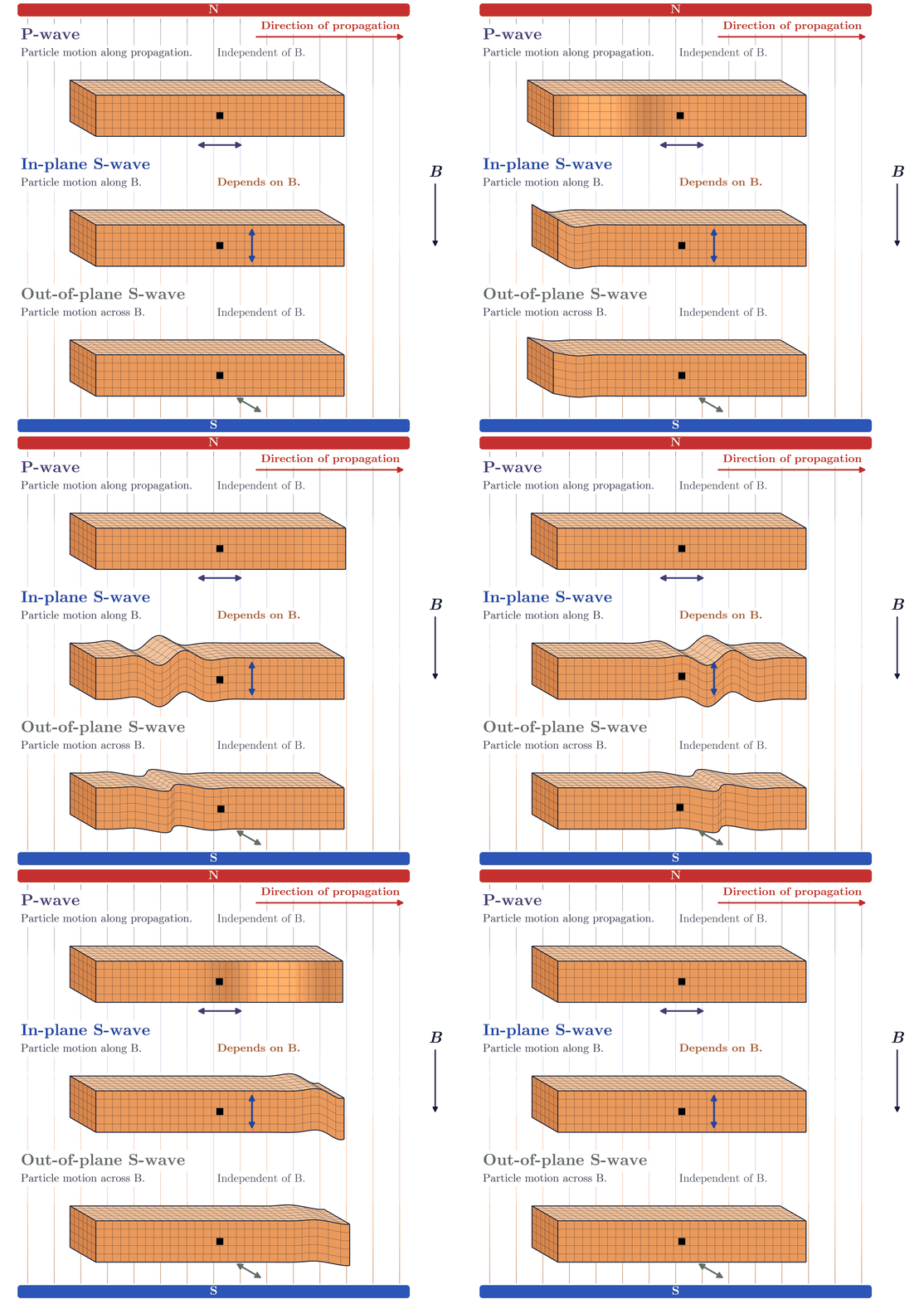
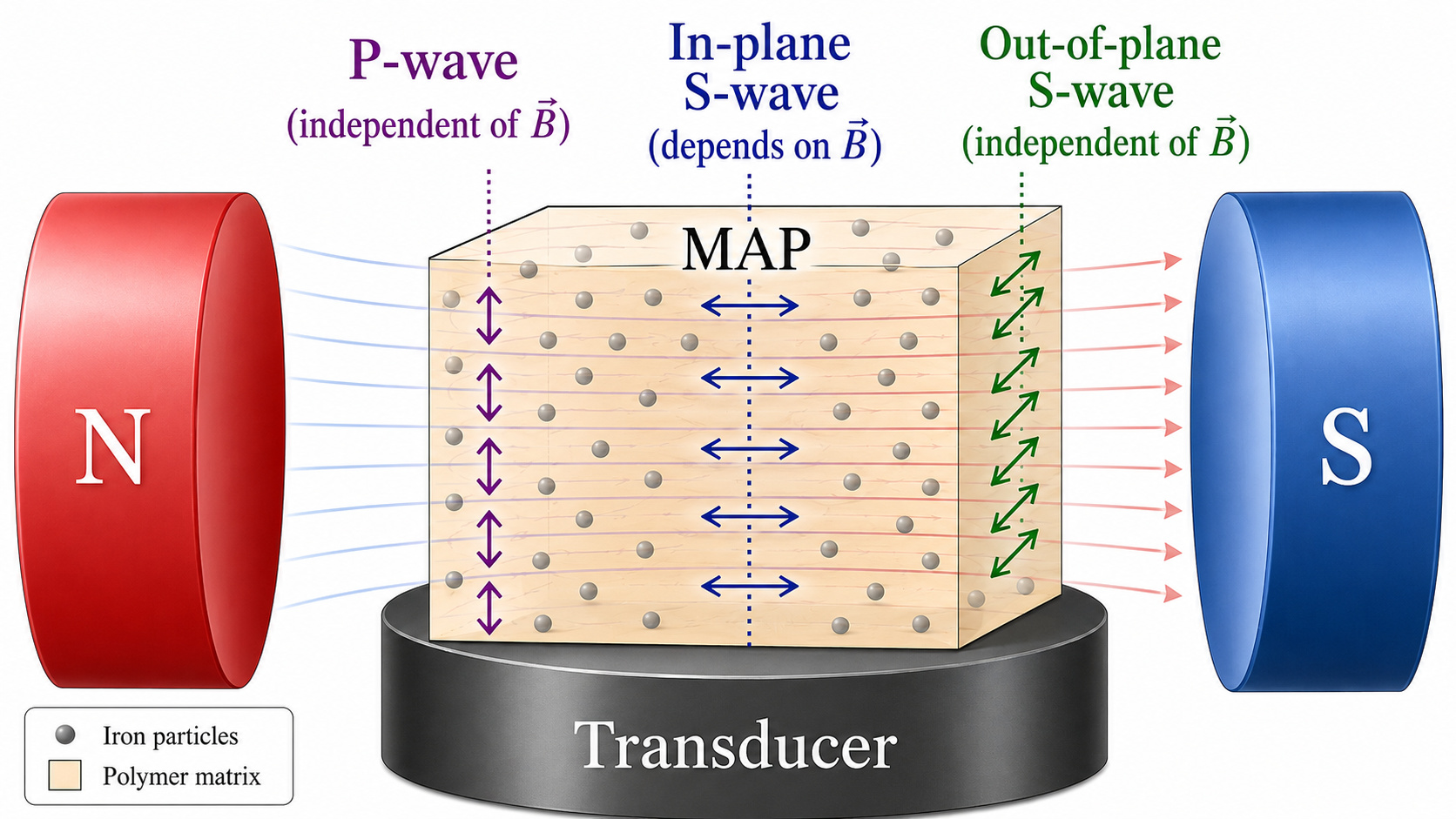
Experimental setup: a magnetoactive polymer sample on an ultrasonic transducer between the north and south poles of a magnet. The P-wave and out-of-plane S-wave are independent of the field; the in-plane S-wave depends on it.
The measurement: the sample sits between the magnet poles on an ultrasonic transducer, with the field across the direction of travel.
The three bulk waves under a transverse field. The longitudinal packet travels about twice as fast as the shear packets, as it does in the real material.

Download the animation: MP4 videoGIF

What I found

  • Closed-form speeds for longitudinal and shear waves in compressible magnetoactive polymers, from an energy function that includes all six invariants.
  • Without pre-deformation, only the shear wave polarised along the field depends on it. The longitudinal wave and the other shear wave do not.
  • That dependence comes entirely from the magneto-mechanical coupling term, and not from the model chosen for the polymer matrix.
  • Ultrasonic pulse-echo measurements on 3D-printed iron–PLA confirmed it: the in-plane shear wave sped up by up to 7 m/s at 1.5 T, while the other two waves did not change.

Read the paper in the International Journal of Mechanical Sciences, 2025.
Surface waves

Rayleigh waves

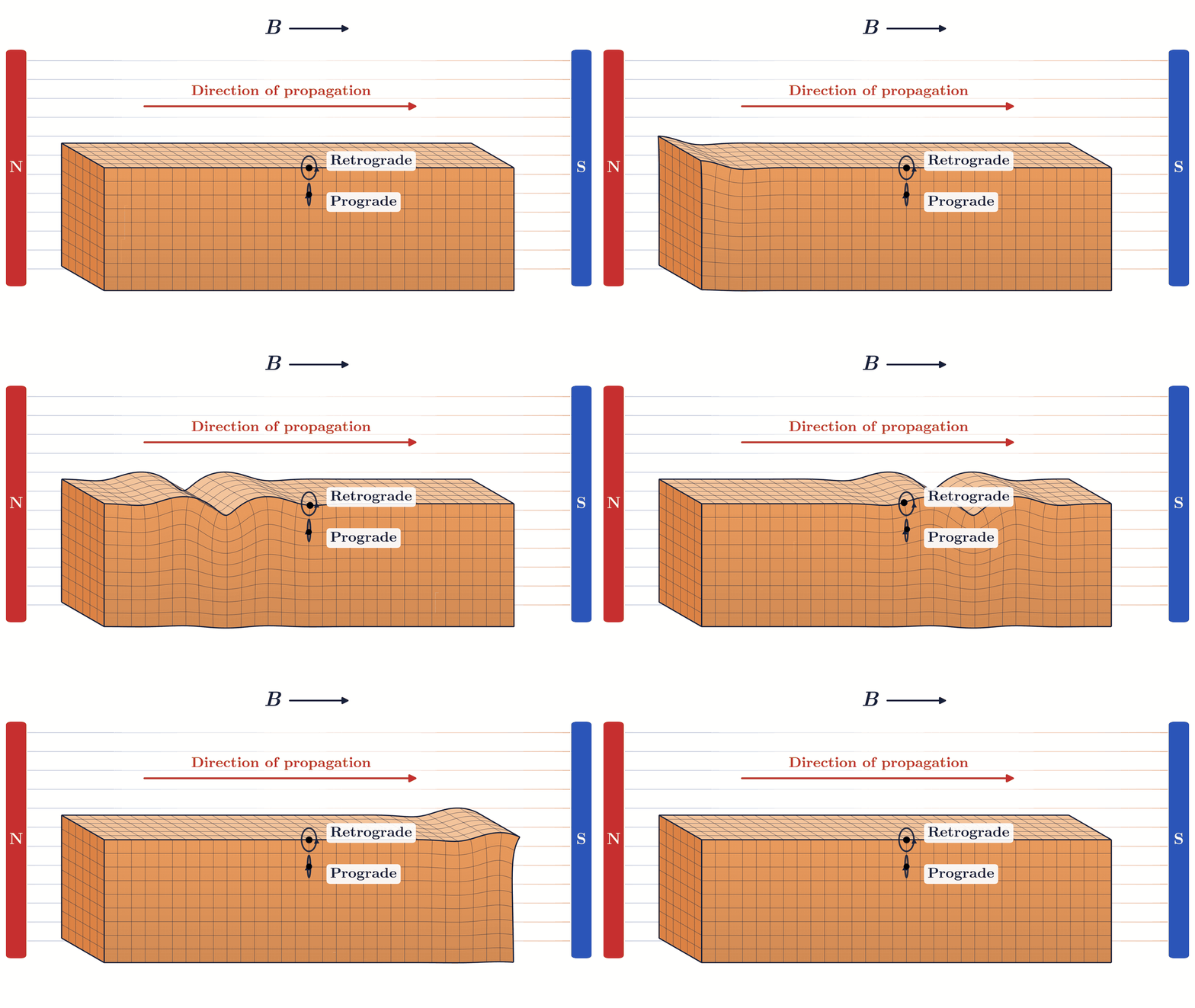
A Rayleigh wave packet with the field along the surface. Surface particles trace retrograde ellipses; below about a fifth of a wavelength the motion turns prograde.

Download the animation: MP4 videoGIF

What I found

  • I formulated the Rayleigh-wave problem for a magnetoactive half-space with the field parallel or perpendicular to the surface.
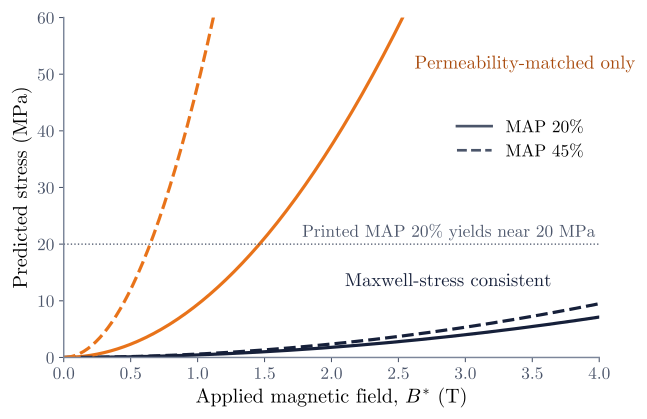
  • Matching the measured magnetic permeability is not enough to fix the model; its coefficients must also reproduce the Maxwell stress of the undeformed material.
  • With Maxwell-stress-consistent coefficients, the field raises the Rayleigh-wave speed slightly, and the wave stays at the surface.
  • Coefficients matched only to permeability make the wave soften and spread into the depth, the signature of a surface instability, which experiments up to 1.6 T did not show.

Read the paper in Advances in Applied Mechanics, 2026.

Love waves Research ongoing

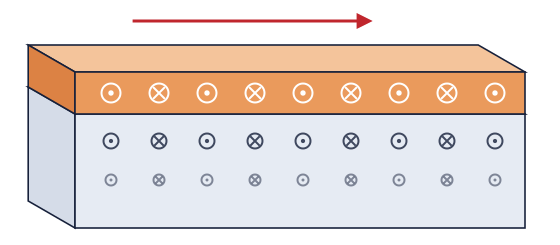
Schematic of a Love wave: a layer on a half-space with particle motion in and out of the page, fading with depth.
Love waves travel in a layer on a half-space, with particles moving parallel to the surface and across the direction of travel.

Why isotropic magnetoactive polymers tune so little

Both studies run into the same two limits.

1. The magnetic energy is far smaller than the elastic energy

The field enters the wave speed only through the ratio , where is the shear modulus and the magnetic permeability. For printed iron–PLA, is about 53 T, so a 1.5 T field gives ≈ 0.03, and the speed changes by less than 1 %.

2. The stress a field can create is capped by the Maxwell stress

In a physically consistent model, the stress in the undeformed material is the Maxwell stress, of order : about 1.2 MPa at 1.5 T, against a shear modulus of 1.5 GPa. Models that allow more, as the chart shows, predict stresses the material could never carry.

Chart of predicted stress against magnetic field. Maxwell-stress-consistent models stay below about 10 MPa up to 4 tesla; models matched only to permeability pass the material's 20 MPa yield stress below 1.5 tesla.
Predicted stress with no deformation, for two iron–PLA compositions.
MatrixShear modulus
Printed iron–PLAabout 1.5 GPaabout 53 T
Soft elastomer, same permeability0.1 to 1 MPaabout 0.4 to 1.4 T

Only soft matrices change this. When falls to the order of a tesla, laboratory fields bring close to one: the field can then deform the material and retune its waves substantially.

Metamaterials for vibration isolation

Future work

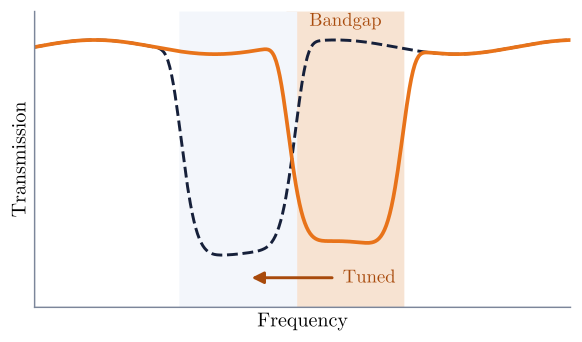
Phononic crystals and locally resonant metamaterials stop vibration inside frequency bands called bandgaps. The hard part is reaching low frequencies, where most machinery and platform vibration lives, without large, heavy cells.

My next work pairs architected phononic structures with field-responsive materials, so that a compact cell can reach low frequencies and its bandgap can be moved on demand. I will say more as the work matures.

Schematic of vibration transmission against frequency, with a bandgap that can be shifted to lower frequencies.
Schematic: a bandgap moved to lower frequencies.

Architected design for energy absorption and dissipation

Manuscript under review

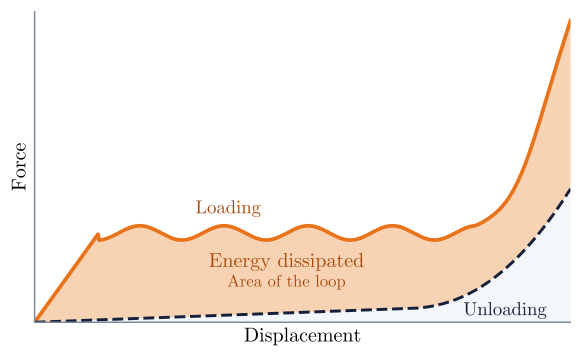
Architected lattices, auxetic designs among them, absorb an impact through the controlled, progressive collapse of their cells. Collapse alone is wasteful: the energy goes into damage, and the structure is spent after one event.

The question I work on is how an architected design can absorb an impact, dissipate the energy, and stay ready for the next load. I will describe the results here once they are published.

Schematic of force against displacement during loading and unloading; the area of the loop between them is the energy dissipated.
Schematic: the energy absorbed while loading, and the part dissipated, the area of the loop.