Technical notes on the physics behind the problems I work on, with the equations, an animation, and the research that shaped each field.
Isolating vibration below 500 Hz
Most of the vibration that troubles machines lives at low frequency: engines, rotors, pumps, reaction wheels and the platforms they sit on put their energy below a few hundred hertz. That is exactly where isolation is hardest, for two reasons, and each has a clean piece of physics behind it.
The classical limit
A mass on a spring and damper transmits a fraction of the base motion given by its transmissibility:
T=(1−r2)2+(2ζr)21+(2ζr)2,r=fnf
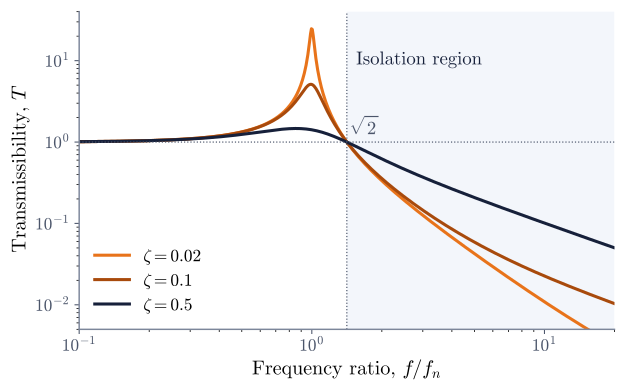
It only isolates when r>2: the natural frequency must sit well below the lowest frequency to be blocked. To isolate everything above 50 Hz, the mount needs a natural frequency under about 35 Hz, and lightly damped mounts amplify violently near resonance.
Transmissibility of a single mount. Isolation starts only above f/fn = √2.
A low natural frequency means a soft spring, and a soft spring sags under the load it carries:
fn=2π1mk=2π1δstg
A 5 Hz mount sags about 10 mm under gravity; a 1 Hz mount would sag about 250 mm. The second difficulty is size. Ordinary periodic structures block waves by Bragg scattering, which needs a cell about half a wavelength long, and below 500 Hz elastic wavelengths in solids run to metres.
Three answers, three eras
Around 2000: local resonance
Liu and colleagues embedded rubber-coated lead spheres in epoxy and showed that internal resonators can stop sound in a material whose cells are about two orders of magnitude smaller than the wavelength. A resonator of mass m inside a cell of mass M gives the cell a frequency-dependent effective mass,
Meff(ω)=M+ω02−ω2mω02,ω0=kr/m
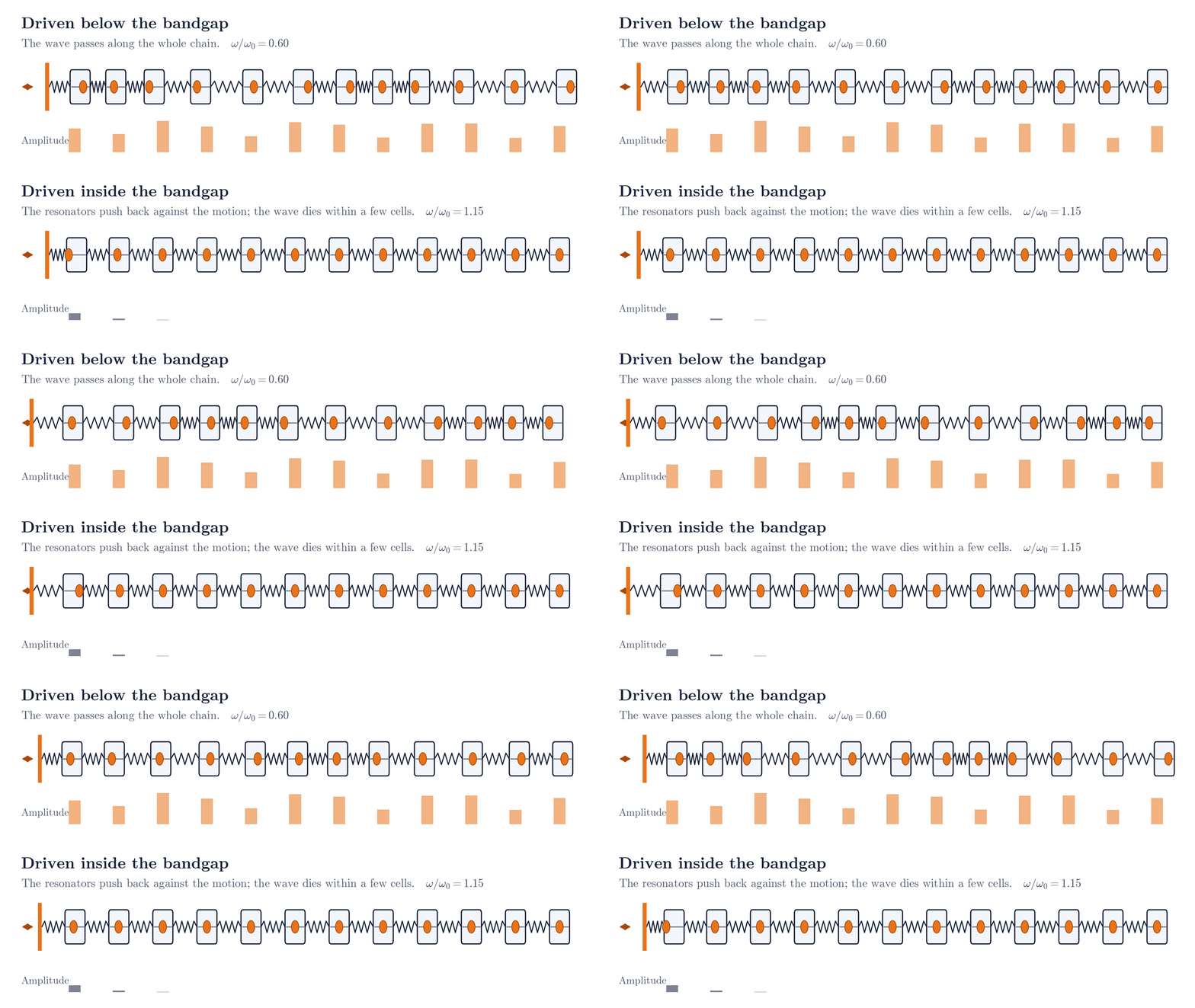
which turns negative for ω0<ω<ω01+m/M: there the cell pushes back against the motion, and the wave cannot propagate. The gap is set by the resonator, not by the cell size.
Around 2007 to 2016: high static, low dynamic stiffness
Carrella, Brennan and Waters analysed an isolator in which oblique springs add negative stiffness to a vertical spring. The mount carries the load stiffly, yet near its working point its dynamic stiffness almost vanishes, so its natural frequency drops without the sag:
kdyn=kv−kneg≈0whilekstatic≫kdyn
Matlack and colleagues then 3D-printed composite metastructures with embedded resonators that absorbed low-frequency, broadband vibration, bringing local resonance into printable parts.
2025: quasi-zero-stiffness metamaterials that carry load
Recent work packs the quasi-zero-stiffness idea into architected cells. Pan and colleagues reported a high load-bearing quasi-zero-stiffness metamaterial whose measured isolation extended up to 300 Hz, and another 2025 study tuned monolithic shells to near-ideal zero stiffness in a compact metamaterial.
See it
An exact steady-state solution for a chain of twelve mass-in-mass cells. Driven below the bandgap, the wave reaches the far end. Driven inside it, the amplitude falls by about four and a half times per cell.
The two ideas are complementary. Quasi-zero stiffness lowers the natural frequency of the whole mount; local resonance removes particular bands that remain. The open problem is to get both into compact, printable cells that still carry their load, and to make the bands tunable.
References
Z. Liu et al., Locally resonant sonic materials, Science 289, 1734 (2000). doi
A. Carrella, M. J. Brennan, T. P. Waters, Static analysis of a passive vibration isolator with quasi-zero-stiffness characteristic, Journal of Sound and Vibration 301, 678 (2007).
K. H. Matlack et al., Composite 3D-printed metastructures for low-frequency and broadband vibration absorption, PNAS 113, 8386 (2016).
G. Pan et al., High load-bearing quasi-zero stiffness metamaterials for vibration isolation, International Journal of Mechanical Sciences 293, 110225 (2025). doi
A compact quasi-zero stiffness metamaterial based on monolithic shells for vibration isolation, npj Metamaterials 1, 2 (2025). doi
Next-generation tiles for submarines and UUVs
The rubber tiles on a submarine's hull do two jobs. They swallow the pings of an enemy's active sonar, so that less echo returns, and they damp the vibration the boat's own machinery would otherwise radiate into the sea. Both jobs are getting harder, because sonar is moving to lower frequencies, where thin coatings do little.
Why a bare hull echoes
When a sound wave in water meets a surface of acoustic impedance Z, part of it is reflected:
R=Z+ZwZ−Zw,α=1−∣R∣2
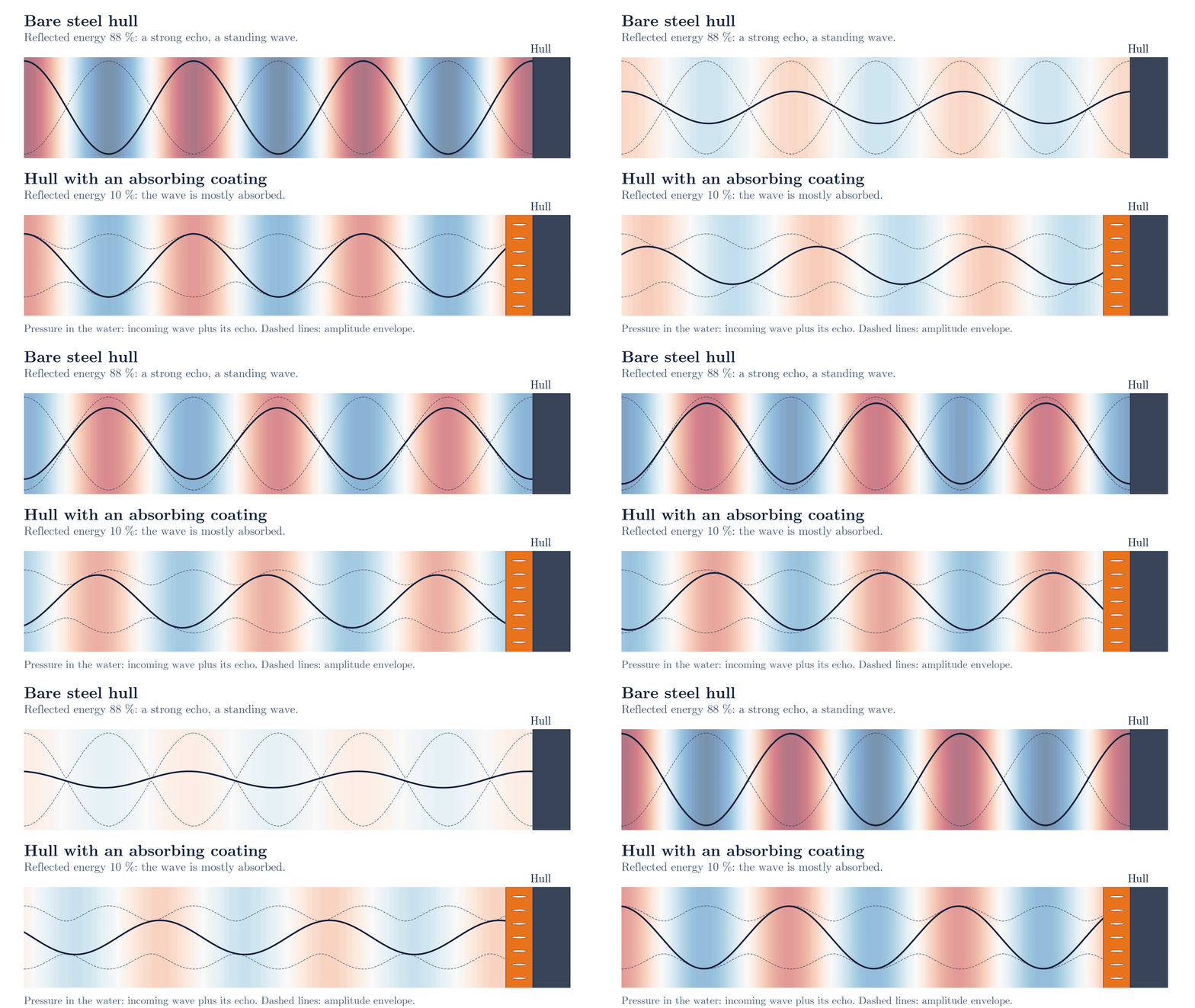
Water has an impedance of about 1.5 MRayl; steel about 46 MRayl. A bare hull therefore reflects about 94 % of the pressure amplitude, 88 % of the energy. A good coating does two things: its face matches the impedance of water, so the wave enters instead of bouncing, and its inside is lossy, so the wave dies there.
The thickness problem
A uniform lossy layer on a steel hull absorbs well only above roughly its quarter-wave frequency,
fλ/4≈4dc
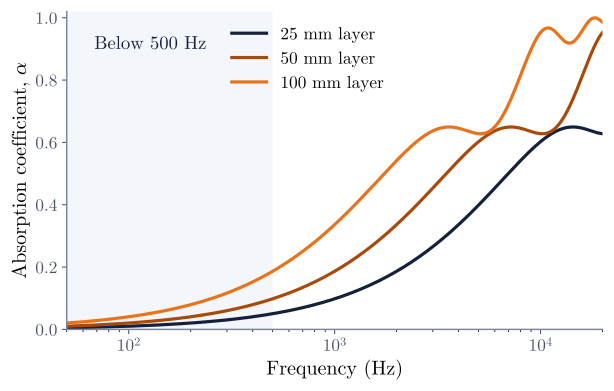
For a rubber-like layer with a sound speed near 1500 m/s, that is 7.5 kHz for a 50 mm layer. Below 500 Hz the same layer absorbs only a few percent, and making it ten times thicker is not an option on a hull.
Absorption of uniform lossy layers on a steel hull, computed from the impedance model above. Below 500 Hz, thickness alone does not help.
Three answers, three eras
Before 2000: cavities in rubber
The Alberich tiles of the 1940s already used rubber with cavities. Under a passing wave the cavities resonate, converting compression into shear in the lossy rubber, where it is dissipated. Hladky-Hennion and Decarpigny modelled these coatings with finite elements in 1991, and the local-resonance work of Liu and colleagues in 2000 showed that resonators can act far below the wavelength.
Around 2006 to 2017: designed cavity arrays
Ivansson optimised viscoelastic coatings with periodic cavities, and Sharma and colleagues analysed gratings of cylindrical voids in a soft medium on a steel backing. The weakness of every cavity design is depth: hydrostatic pressure squeezes the cavities, stiffens the coating and pushes its resonances up and out of the band they were tuned for.
2025: thin, pressure-resistant metamaterials
Recent designs aim at all three requirements at once. Yan and Wang used thin-film metamaterials to absorb at 0.1 to 1 kHz under high hydrostatic pressure; another 2025 study reported broadband low-frequency absorption from a coating only 20 mm thick under pressure; and a 2025 review in Acta Acustica traces the line from the Alberich tile to these metamaterials.
See it
Pressure in the water in front of a hull: the incoming wave plus its echo, exact for the stated reflection. The bare hull sets up a strong standing wave. An idealised coating that absorbs 90 % of the energy leaves an almost pure travelling wave.
The next-generation tile has to be thin, keep its tuning under pressure, absorb below 1 kHz, and decouple the hull's own vibration as well as absorb sonar. Architected internal structure, rather than material alone, is where those requirements meet.
References
A.-C. Hladky-Hennion, J.-N. Decarpigny, Analysis of the scattering of a plane acoustic wave by a doubly periodic structure using the finite element method: application to Alberich anechoic coatings, Journal of the Acoustical Society of America 90 (1991).
Z. Liu et al., Locally resonant sonic materials, Science 289, 1734 (2000). doi
S. M. Ivansson, Sound absorption by viscoelastic coatings with periodically distributed cavities, Journal of the Acoustical Society of America 119 (2006).
G. S. Sharma et al., Acoustic performance of gratings of cylindrical voids in a soft elastic medium with a steel backing, Journal of the Acoustical Society of America 141 (2017).
T. Yan, K. Wang et al., Application and control mechanism of thin film metamaterials in underwater sound-absorbing materials at low frequency under high hydrostatic pressure, Applied Acoustics 231, 110535 (2025). doi
A novel underwater acoustic absorbing coating for low-frequency and broadband sound based on liquid–solid synergistic mechanism, Physics Letters A 537, 130307 (2025). Link
A review of acoustic metamaterials for naval and underwater defense applications: from historical concepts to new trends, Acta Acustica (2025). Link